
We need to worry about Bella and Charlie: the impacts of pet cats on Australian wildlife; How many birds are killed by cats in Australia?; The impact of cats in Australia: Threatened Species Recovery Hub
Adventure Cat Training & Behaviour Coaching
We help guardians raise calm, confident adventure cats and create enriched indoor lives and safe outdoor experiences that respect feline welfare and protect wildlife. We provide evidence-based adventure cat coaching, feline behaviour support, and practical education for individuals and organisations.
What adventure cat training delivers
- Welfare with purpose — structured outlets for natural behaviours—exploration, climbing, scratching, predation-sequence play, sensory stimulation— without the wildlife toll. Guided practice with rewards (reinforcement) channels instincts into safe routines.
- Safer, calmer outings — cue-based functional skills (direction & place control, loose-lead walking, sit/wait/recall) build confidence and awareness, resulting in reduced startle, flight response and frustration. Gradual exposure with good things (desensitisation + counter-conditioning) builds resilience.
- Better communication — clear cues and timely reinforcement make your cat more adaptable in new situations and less likely to react from fear. Predictable routines and choice increase a sense of autonomy and control.
- Stronger bond — as your cat better understands its environment and your signals, the bond between you deepens, leading to a more rewarding and fulfilling relationship. It’s a win–win!
Who is this for?
Indoor-only
Stronger communication and enrichment for a happier and easier life together.
Beginners
Starting from scratch with direction/place control and first outings.
Intermediates
Calmer walks with loose-lead skills, impulse control, routines and clear cues.
Advanced
Off-leash skills, focus and resilience for confident teams in complex spaces.
Organisations
Talks, workshops, PD and live demos on welfare, training and communication.
We meet you where you’re at. Every consult is tailored to your goals, your cat’s temperament, and your home environment. We use evidence-based methods and coach you step-by-step. Because successful behaviour change depends on history and consistent implementation, we cannot guarantee specific outcomes. We provide services with due care and skill and will design a plan specifically for your cat.
For Individuals
Starter Consultation (90-120 min)
- Intake form/interview: history and context + up to 3 short videos.
- Functional behaviour assessment: A-B-C mapping to infer likely function(s), and set immediate antecedent/reinforcement tweaks.
- Goal setting with keystone-skill: Practical, measurable targets tailored to your home and adventures, with coaching in core skills.
- Written step-by-step training plan: tailored to your cat and household (~4-6 weeks worth)
- Two weeks of support: check-ins whilst you get started, for questions and small tweaks.
$330 AUD (Online)
*Face-to-Face within 8km of South Yarra VIC 3141; >8km by arrangement + travel fee
Follow-up (60 min)
- Progress review: wins, roadblocks, and data from practice.
- Goal review & update: tighten priorities and success criteria.
- Targeted, outcome-focused coaching: sharpen criteria, adjust antecedents/reinforcement, and advance key skills.
- Updated training plan: clear next steps for the coming phase.
$150 AUD (Online)
*Face-to-Face by arrangement + travel fee
Check In & Tune Up (30 min)
- One clear priority: at the start we agree on the single focus for this session.
- Flexible use of time: troubleshooting, micro-coaching, gear fit/handling tips, criteria tweaks, or ‘what’s next’.
- Targeted coaching: immediate adjustments to antecedents/reinforcement and 1–2 techniques to try now.
- Session summary & next steps: email with dot points + key actions.
- Optional: bring one short video clip (≤60s) if it helps illustrate the issue.
$90 AUD (Online)
Note: All consults are online by default. Face-to-face Starter Consultations are available within 8 km (driving distance) of South Yarra Station at no extra cost. Beyond 8 km, face-to-face is by arrangement and a travel fee applies (see below). Follow-ups are online; face-to-face follow-ups are available by arrangement + travel fee. You may meet us for an outdoor face-to-face constult and demonstration with Kepler at our South Yarra location (no travel fee).
Travel time is charged at $50/hour ($0.83/min) using Google Maps driving time from South Yarra Station, VIC 3141 to your address. Set Maps to ‘Arrive at’ the appointment time. If Google Maps shows a time range, we use the midpoint of that range. Travel is charged round trip (there + back) and rounded up to the nearest 5 minutes. The travel fee is confirmed at booking and does not change due to traffic on the day.
What we do (includes but not limited to):
- Confidence building — functional skills and tricks to promote confidence and make life easier, safer and more enjoyable.
- Harness & lead walking — we prioritise the loose-lead ‘follow’ technique so your cat walks with you.
- Core training & communication skills — direction, place and impulse control, recall; words, signals and talking buttons for effective communication.
- Carrier comfort & travel readiness — car skills and calm routines for short and long trips; bike rides, camping, hotels and road trips.
- Indoor enrichment that works — tricks, games, play, puzzles, and environment design.
- Backpack / pram training — carry, settle, safe in/outs (inside and on topof backpack).
- Wildlife-safe adventures — timing, routes, and trail etiquette; interspecies socialisation; shaping instinct and prey drive.
- Safety outside & around dogs — environmental awareness and space managemet; reading body language and supervising interactions.
- Troubleshooting — harness & lead problems, noise sensitivity, over-arousal, prey drive, door-dashing, carrier/car stress, travel toileting, calm settles.
- Gear guidance — harness/lead selection and fitting, backpacks, carriers, travel setups, first aid awareness.
- Food & nutrition guidance — practical, welfare-first advice on feeding routines and enrichment (non-clinical; see your vet for medical needs).
For Councils, Schools, & Organisations
We support schools, councils and organisations with keynotes, workshops and live demonstrations that build community buy-in for cat containment and wildlife protection. These sessions equip guardians and young people with practical skills to keep cats safe and enriched through supervised outdoor adventures and structured indoor enrichment activities — made possible with evidence-based training, routines and the right gear.
Formats: Keynote talks • Interactive workshops • Staff PD • Community info sessions • Incursions/assemblies for primary and secondary schools (can be explicitly tied to Science Curriculum Outcomes) • Live Demonstrations • In-person (Melbourne) or online
Objectives / Outcomes:
- Clear understanding of why containment matters in Australia
- Practical, welfare-first steps for supervised outdoor time
- Core training and communication skills guardians can apply immediately
- Indoor enrichment strategies that reduce stress and problem behaviour
- Travel routines for calmer, safer outings
- Wildlife-safe etiquette for paths, parks and shared spaces
Topics we can cover:
- Foundations of training & communication (markers, cues, rewards)
- Indoor enrichment that actually works (play, puzzles, environment design)
- Travel & vet readiness (carrier comfort, car skills, calm routines)
- Harness & leash training (fit, loose-lead walking, recall/follow)
- Backpack training (gradual exposure, safety)
- Wildlife-safe adventures (timing, routes, species-aware etiquette)
- Safety outside & around dogs (space management, reading body language)
- Community education: curfews, containment & compliance (behaviour-led)
Booking: Get In Touch to discuss your needs, or email us for session outlines, fees, and dates: staff@mrbeauty.co
(We can tailor content to local policies, curricuclum and audiences.)
How Adventure Cat Training Works
Training isn’t a bag of tricks; it’s a way of living together, communicating clearly, and giving your cat the skills and confidence to explore the world with you. My mission is to help you and your cat unlock a world of safe, enriching adventures.
I work with both species in the partnership: your cat and you. Drawing on behaviour science and my background in education, I’ll teach you how cats learn, what motivates them, and how to use that knowledge to support their wellbeing, build trust, and create a shared language.
I weave together behaviour science, practical adventure-cat skills learned from years of hands-on work, and lifestyle coaching that helps you integrate training into your routines, home environment, and goals. Together we create experiences that support your cat’s physical health, mental stimulation, and emotional wellbeing while staying doable for you. Whether you picture relaxed park strolls, weekends hiking in the bush, café visits or camping trips, my job is to design a path that gets you there safely and sustainably, with a cat who genuinely enjoys the journey.
My Methods
I bring two kinds of science to every consult: behaviour science for your cat, and learning science for you. That way, we’re not just hoping training will work — we’re designing it to work.
For Cats — Evidence-Based Behaviour Science
I use the principles of behaviourism to teach safe, feline-appropriate skills for outdoor exploration. I use functional behaviour assessment to understand why a behaviour is happening and what is reinforcing it. In practice, teaching new behaviours and changing existing ones looks like this:
- Reinforcing desired behaviours rather than punishing unwanted ones
- Using shaping, differential reinforcement, desensitisation, counterconditioning, stimulus control to build complex skills step by step
- Creating environments that make success easy and mistakes unlikely
All of our work is welfare-first, using positive and minimally aversive methods (never fear or pain) that respect your cat’s individual needs, body language, and natural behaviour.
For Humans — Proven Learning Strategies
Training a cat is only half the story. The other half is training you to train your cat. I draw on my background in education to use effective human-learning strategies:
- Breaking information into manageable steps
- Demonstrating skills, then guiding you to practise
- Supporting you to transfer skills into real-life situations
My experience in curriculum design means every training plan is carefully structured for progress. I map out clear goals, break them into achievable steps, and create the right conditions for both cats and humans to succeed.
Adventure Cat’s Ikigai
At the heart of my work is the belief that optimal physical, psychological, and emotional wellbeing is the foundation for every adventure cat’s success. The Ikigai model recognises that a thriving adventure cat needs balance across four interconnected pillars — Health & Nutrition, Lifestyle, Activity & Exercise, and Education.
Where these pillars meet is where your cat’s wellbeing flourishes — and where you and your cat can share your best adventures together:
- Lifestyle-based learning — Training is woven into everyday life, using positive reinforcement and real-world experiences at home and outdoors so your cat learns in the context where they actually live and adventure.
- Physical & mental fitness — Movement, play and exploration are paired with cognitive challenges and appropriate nutrition so your cat stays strong, agile, and mentally engaged.
- Holistic wellness — Balanced nutrition, preventative health care, and low-stress environments support your cat’s body and mind, building a confident, well-adjusted adventure companion.
- Safe & stimulating adventures — Carefully planned outings, gear, and training allow your cat to explore exciting environments while staying safe, supported, and responsive to you.
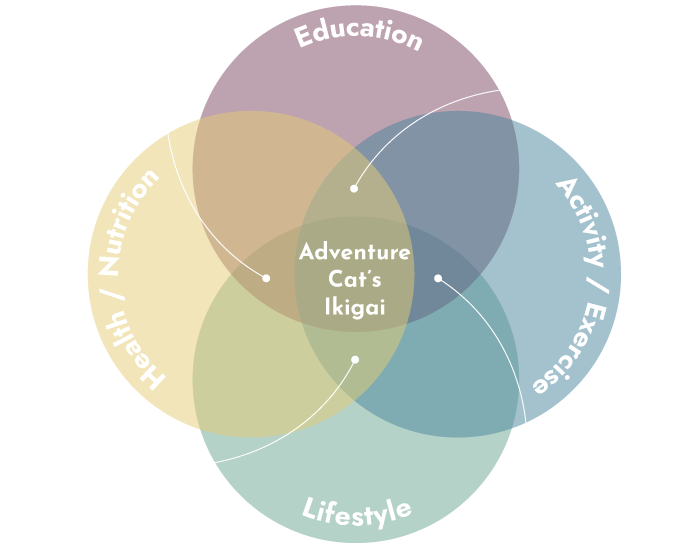
The Four Pillars of the Adventure Cat Lifestyle
The Ikigai model shows where things converge; these four pillars describe what we actually focus on together to get your cat ready for safe, joyful adventures.
Health & Nutrition
Physical wellbeing is the foundation of an adventurous life. I offer non-prescriptive guidance on species-appropriate, biologically balanced diets; using nutritious treats for training; hydration strategies for home and travel; and preparing for the physical demands of outdoor activities. We also cover preventative care, at-home maintenance like nail trimming and dental hygiene, and first aid for adventures — so your cat can enjoy a long, healthy, active life.
.
In practice, this might look like: adjusting meal timing around outings, refining treat choices for training, or building a simple adventure first-aid kit.
Lifestyle
A secure, enriching home base and predictable routines give your cat the confidence to explore. Together we design spaces where your cat can observe the world, safe access to exploration areas, the right gear for every season, and social connection with humans and other animals. We shape adaptable routines that respond to your cat’s changing needs and promote a deep sense of stability and security.
.
In practice, this might look like: upgrading your window watching spots, setting up safe ‘base camps’ outdoors, or adjusting daily rhythms to support calmer departures and returns.
Activity & Exercise
Adventure cats need movement, challenge, and fun. From walks and hikes to climbing, scratching, and interactive play, we pair physical activities with mental stimulation. Every outing becomes an opportunity to build skills, reinforce training, and give your cat the joy of expressing natural behaviours like exploring, chasing, running, and climbing.
.
In practice, this might look like: planning graded adventure routes, introducing new play patterns, or creating mini ‘parkour’ setups that safely build strength and coordination.
Education
Education is where you and your cat learn together. I help you understand how your cat learns, what motivates them, and how to communicate clearly. Drawing on behaviourology and learning theory, we develop practical skills — harness walking, recall, safe tree climbing, travel readiness — and functional tasks that make adventures smoother and safer. Education empowers both you and your cat, turning every adventure into a shared learning experience.
.
In practice, this might look like: step-by-step training plans, refining your handling and timing, or troubleshooting specific behaviours that show up on adventures.
Same Species, Different Needs
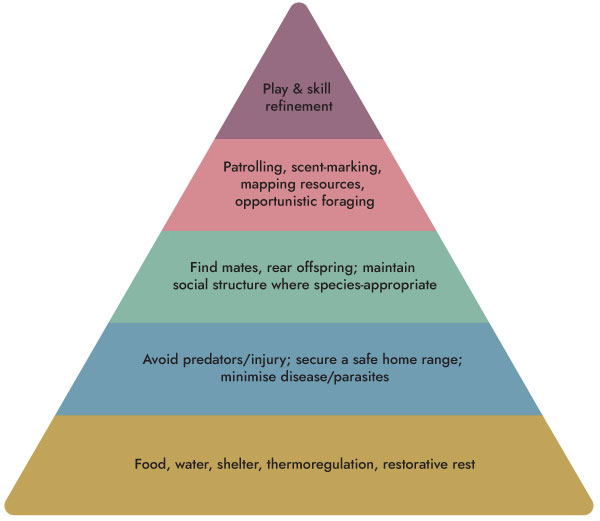
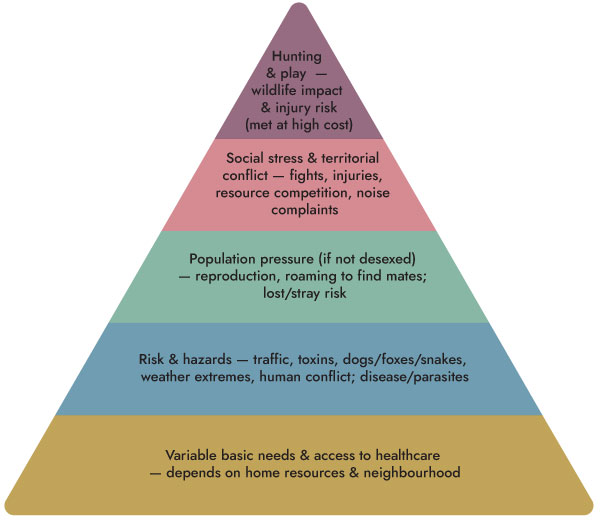
Domestic cats share a ancestry with wild felids overseas, but they live a very different life. A wild cat, a free-roaming pet, and a carefully trained adventure cat can look similar on the outside, yet their priorities, risks, and welfare needs are worlds apart. These three pyramids show how their needs diverge.
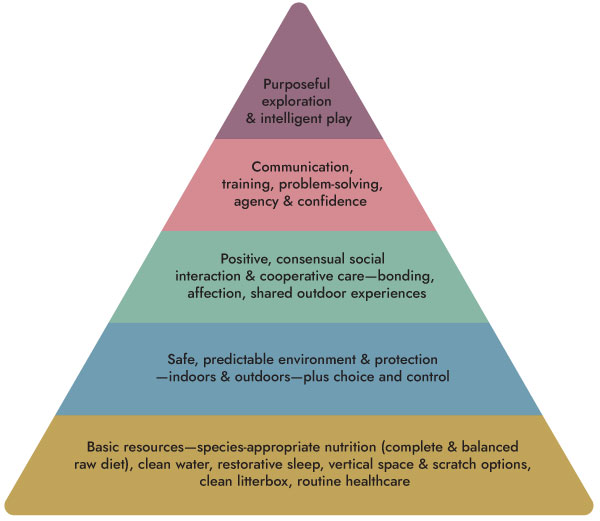
AAFP and ISFM Feline Environmental Needs Guidelines
How we use this in practice
This hierarchy is our roadmap. It shapes every training plan and helps us decide what each cat needs next, so that adventure becomes the final expression of a secure, well-supported life — not a substitute for it.
In consults we look at which layer is rock-solid, which is wobbly, and which is missing altogether. Sometimes that means working on litterbox hygiene or sleep routines before we talk about harness skills; sometimes it means building communication and confidence before we add more challenging hikes. The goal is always the same: a cat who is physically safe, emotionally resilient, and able to thrive in a variety of environments.
Together, these three models keep us honest. The wild cat hierarchy reminds us what cats evolved to do; the free-roaming risk profile shows what happens when we hand that responsibility to busy streets and back fences; and the Adventure Cat’s hierarchy gives us a structured, welfare-first alternative. Whether a cat is currently indoors-only, roaming, or already adventuring, we use these frameworks to move them towards a life where their needs are met, their risks are managed, and their natural cat-ness has safe, satisfying ways to shine.