
How I Work With Cats
Training isn’t a bag of tricks; it’s a way of living together, communicating clearly, and giving your cat the skills and confidence to explore the world with you. My mission is to help you and your cat unlock a world of safe, enriching adventures.
I work with both species in the partnership: your cat and you. Drawing on behaviour science and my background in education, I’ll teach you how cats learn, what motivates them, and how to use that knowledge to support their wellbeing, build trust, and create a shared language.
I weave together behaviour science, practical adventure-cat skills learned from years of hands-on work, and lifestyle coaching that helps you integrate training into your routines, home environment, and goals. Together we create experiences that support your cat’s physical health, mental stimulation, and emotional wellbeing while staying doable for you. Whether you picture relaxed park strolls, weekends hiking in the bush, café visits or camping trips, my job is to design a path that gets you there safely and sustainably, with a cat who genuinely enjoys the journey.
My Methods
I bring two kinds of science to every consult: behaviour science for your cat, and learning science for you. That way, we’re not just hoping training will work — we’re designing it to work.
For Cats — Evidence-Based Behaviour Science
I use the principles of behaviourism to teach safe, feline-appropriate skills for outdoor exploration. I use functional behaviour assessment to understand why a behaviour is happening and what is reinforcing it. In practice, teaching new behaviours and changing existing ones looks like this:
- Reinforcing desired behaviours rather than punishing unwanted ones
- Using shaping, differential reinforcement, desensitisation, counterconditioning, stimulus control to build complex skills step by step
- Creating environments that make success easy and mistakes unlikely
All of our work is welfare-first, using positive and minimally aversive methods (never fear or pain) that respect your cat’s individual needs, body language, and natural behaviour.
For Humans — Proven Learning Strategies
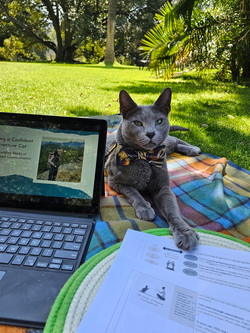
Training a cat is only half the story. The other half is training you to train your cat. I draw on my background in education to use effective human-learning strategies:
- Breaking information into manageable steps
- Demonstrating skills, then guiding you to practise
- Supporting you to transfer skills into real-life situations
My experience in curriculum design means every training plan is carefully structured for progress. I map out clear goals, break them into achievable steps, and create the right conditions for both cats and humans to succeed.
Adventure Cat’s Ikigai
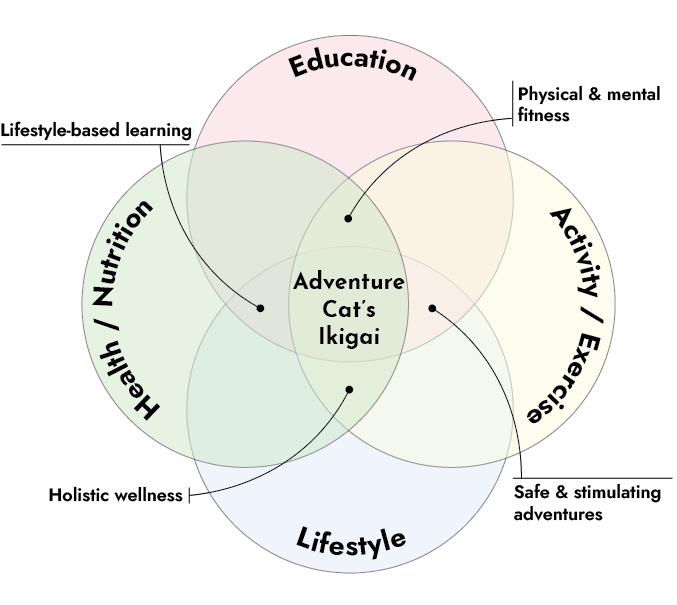
At the heart of my work is the belief that optimal physical, psychological, and emotional wellbeing is the foundation for every adventure cat’s success. The Ikigai model recognises that a thriving adventure cat needs balance across four interconnected pillars — Health & Nutrition, Lifestyle, Activity & Exercise, and Education.
Where these pillars meet is where your cat’s wellbeing flourishes — and where you and your cat can share your best adventures together:
- Lifestyle-based learning — Training is woven into everyday life, using positive reinforcement and real-world experiences at home and outdoors so your cat learns in the context where they actually live and adventure.
- Physical & mental fitness — Movement, play and exploration are paired with cognitive challenges and appropriate nutrition so your cat stays strong, agile, and mentally engaged.
- Holistic wellness — Balanced nutrition, preventative health care, and low-stress environments support your cat’s body and mind, building a confident, well-adjusted adventure companion.
- Safe & stimulating adventures — Carefully planned outings, gear, and training allow your cat to explore exciting environments while staying safe, supported, and responsive to you.
The Four Pillars of the Adventure Cat Lifestyle
The Ikigai model shows where things converge; these four pillars describe what we actually focus on together to get your cat ready for safe, joyful adventures.
Health & Nutrition
Physical wellbeing is the foundation of an adventurous life. I offer non-prescriptive guidance on species-appropriate, biologically balanced diets; using nutritious treats for training; hydration strategies for home and travel; and preparing for the physical demands of outdoor activities. We also cover preventative care, at-home maintenance like nail trimming and dental hygiene, and first aid for adventures — so your cat can enjoy a long, healthy, active life.
In practice, this might look like: adjusting meal timing around outings, refining treat choices for training, or building a simple adventure first-aid kit.
Lifestyle
A secure, enriching home base and predictable routines give your cat the confidence to explore. Together we design spaces where your cat can observe the world, safe access to exploration areas, the right gear for every season, and social connection with humans and other animals. We shape adaptable routines that respond to your cat’s changing needs and promote a deep sense of stability and security.
In practice, this might look like: upgrading your window watching spots, setting up safe “base camps” outdoors, or adjusting daily rhythms to support calmer departures and returns.
Activity & Exercise
Adventure cats need movement, challenge, and fun. From walks and hikes to climbing, scratching, and interactive play, we pair physical activities with mental stimulation. Every outing becomes an opportunity to build skills, reinforce training, and give your cat the joy of expressing natural behaviours like exploring, chasing, running, and climbing.
In practice, this might look like: planning graded adventure routes, introducing new play patterns, or creating mini ‘parkour’ setups that safely build strength and coordination.
Education
Education is where you and your cat learn together. I help you understand how your cat learns, what motivates them, and how to communicate clearly. Drawing on behaviourology and learning theory, we develop practical skills — harness walking, recall, safe tree climbing, travel readiness — and functional tasks that make adventures smoother and safer. Education empowers both you and your cat, turning every adventure into a shared learning experience.
In practice, this might look like: step-by-step training plans, refining your handling and timing, or troubleshooting specific behaviours that show up on adventures.
Same Species, Different Needs
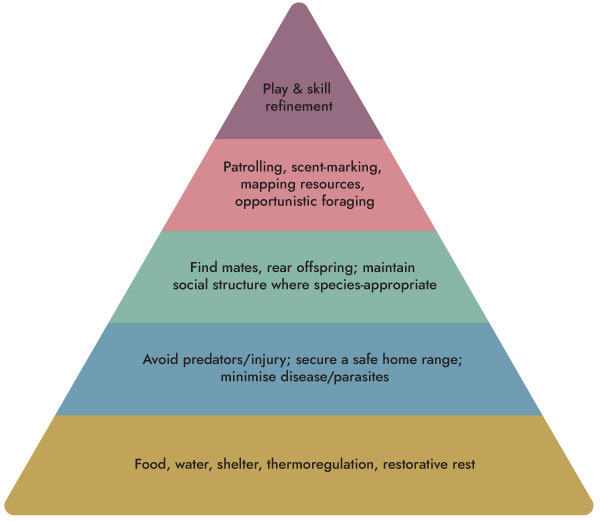
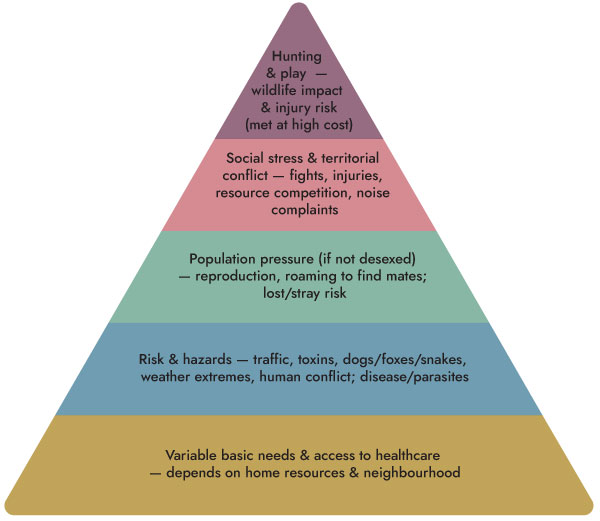
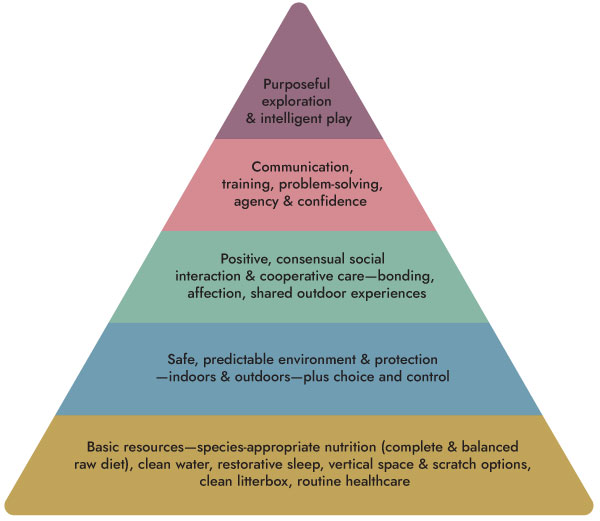
Domestic cats share a ancestry with wild felids overseas, but they don’t all live the same kind of life. A wild cat, a free-roaming pet, and a carefully trained adventure cat can look similar on the outside, yet their priorities, risks, and welfare needs are completely different. These three pyramids show how those worlds diverge.
How we use this in practice
This hierarchy is our roadmap. It shapes every training plan and helps us decide what each cat needs next, so that adventure becomes the final expression of a secure, well-supported life — not a substitute for it.
In consults we look at which layer is rock-solid, which is wobbly, and which is missing altogether. Sometimes that means working on litterbox hygiene or sleep routines before we talk about harness skills; sometimes it means building communication and confidence before we add more challenging hikes. The goal is always the same: a cat who is physically safe, emotionally resilient, and able to thrive in a variety of environments.
Together, these three models keep us honest. The wild cat hierarchy reminds us what cats evolved to do; the free-roaming risk profile shows what happens when we hand that responsibility to busy streets and back fences; and the Adventure Cat’s hierarchy gives us a structured, welfare-first alternative. Whether a cat is currently indoors-only, roaming, or already adventuring, we use these frameworks to move them towards a life where their needs are met, their risks are managed, and their natural cat-ness has safe, satisfying ways to shine.
Readiness checklist
Button: book a starter → #book
Layout & style:
- Keep this on a light tint (different from readiness) for contrast.
- Use Spectra FAQ/Accordion with a slim border between items.
6) locations & travel
Anchor: locations
Blocks: Container → Heading, Columns(3) Info Box cards, Tiny paragraph
Heading (H2):
Where sessions happen
Cards:
- online (zoom): base price
- meet us in south yarra (kings domain / royal botanic gardens): base price
- your location: base price + travel — $50 per started 30 minutes of round-trip travel from south yarra. we cover parking and tolls.
Tiny paragraph:
outdoor sessions move online or reschedule if not cat-safe (heavy rain, poor air quality, or forecast ≥35 °c).
Layout & style:
- Give this a soft tinted background band.
- Use simple icons (laptop • map pin • house).
7) methods (ikigai + reinforcement)
Anchor: methods
Blocks: Container (alt background) → Heading, Columns(2) Info Box + Image (Lightbox)
Heading (H2):
Our framework and methods
Column A (ikigai copy):
adventure cat ikigai: four pillars—health, lifestyle, activity, education. we use this to pace training, protect welfare, and design a plan you can actually live with.
Image: ikigai diagram (SVG). Alt: four-pillar diagram showing health, lifestyle, activity and education.
Column B (reinforcement copy):
cats repeat what pays. we make the right choice easy and rewarding, prevent practice of the wrong one, and teach a better alternative.
Image: reinforcement infographic (SVG). Alt: guardian rewarding a cat; rewarded behaviours increase.
Tiny note: positive reinforcement only; off-leash only in secure spaces.
Optional button: book a starter → #book
Layout & style:
- Use a distinct tint (e.g., pale sand) to showcase diagrams; enable Lightbox.
- Plenty of breathing room (32–40px padding).
safety builds freedom — structured, welfare-first steps turn curiosity into confident choices.”
8) outcomes
Anchor: outcomes
Blocks: Container → Heading, Icon List, Button
Heading (H2):
What changes first
Bullets:
- slack returns to the leash sooner
- easier, calmer carrier entries
- faster recovery after surprises
- more check-ins and steadier exploration
- clear “level-up” signals so you know when to progress
- you feel confident running 5–10 minute daily reps
Button: book a starter → #book
Layout & style:
- Back to white for contrast.
- Use a 6-icon grid (2×3 on desktop; 1×6 on mobile).
9) who we help
Anchor: who
Blocks: Container → Heading, Columns(4) Info Box cards, Button
Heading (H2):
Who we help
Cards:
- guardians (1:1): harness fit, loose-lead walking, travel prep, enrichment, troubleshooting
- schools and organisations: talks and workshops on enrichment, secure leash skills, biodiversity — contact for pricing
- councils: community education on responsible cat care — contact for pricing
- vets and animal services: staff pd, client education, welfare policies — contact for pricing
Button: enquire → /contact-book/
Layout & style:
- Keep this on a tint to set it apart from Outcomes and FAQs.
- Simple 4-card grid (2×2 on tablet/mobile).
10) faqs
Anchor: faqs
Blocks: Container → Heading, FAQ/Accordion, Button
Heading (H2):
FAQs
Items:
- do you work with fearful cats? yes — we lower criteria, protect choice, and move at your cat’s pace.
- do i need a specific harness? we’ll check fit and suggest options if needed.
- do you train off-leash? only in secure spaces. recall is taught as a safety skill first.
- where do sessions happen? online, meet us in south yarra, or your location (travel applies).
- what does “support” include? starter: two messages per week for two weeks. starter plus: two per week for four weeks. once during starter, you can swap a week’s messages for a single video review (≤5 min).
- how do you calculate travel? $50 per started 30 minutes of round-trip travel from south yarra. we cover parking and tolls.
- can i pay as i go? yes — $180/hour pro-rata (e.g., $135/45 min, $90/30 min, $45/15 min).
- do i get the training 101 resource? yes — Adventure Cat Training 101 (starter edition) is included with any booking.
Button: ready to book? → #book
Layout & style:
- Keep FAQs on white with dividers between items; minimal shadows.
- Add a small book button at the end.
11) book (booking form)
Anchor: book
Blocks: Container → Heading, booking widget or Spectra Form
Heading (H2):
Book your session
Form fields (if using Spectra):
service (starter · starter plus · training 4-pack · drop-in 60/45/30/15 · video coaching) • location (online · meet us · your location) • if “your location”, travel tier (≤30 · 31–60 · 61–90 min round-trip) • preferred date/time • name • email • mobile • cat name/age • notes • consent ticks (positive methods; weather safety; optional media)
Tiny line:
services are delivered with due care and skill; outcomes vary by cat and context.
Layout & style:
- Make this a highlight band with a soft tint and a subtle border or shadow around the form.
- Keep inputs large; stack on mobile; sticky “submit” visible on small screens.
quick note on the impact statistic
For the banner line, use a verified local stat when you have it. Until then, keep it general (“pet cats impact wildlife significantly; secure, supervised training helps”). When you’re ready, drop the number into the [insert verified number] slot.
how to make a long page feel light
- Add a sticky mini-nav (jump links).
Put a slim bar under the main header with links toreadiness · packages · pathways · how · locations · methods · outcomes · faqs · book.
Spectra blocks: Container (full width) → Horizontal Icon List or Buttons; set “sticky” in your theme/header options. - Repeat your primary CTA.
A “book a starter consult” button in Header, Readiness, each Package card, under Pathways, How, Methods, Outcomes, and FAQs (all link to#book). - Use progressive disclosure.
Keep Pathways and FAQs in accordions. Short, one-line intros everywhere else; details live in the plan email after booking. - Give one fast TL;DR.
In the Header, keep the one-liner: “90-min starter → 2-week plan + short support + Training 101.” That’s the promise. - Visual rhythm.
Alternate backgrounds: white → photo banner (impact slider) → light tint → white → another tint, etc. You’ve planned this; keep paddings tight on mobile. - Back-to-top.
Add a tiny “↑ back to top” button after FAQs.
2) readiness checklist (hierarchy)
–this creates a barrier to entry, person can easily see that they’re not ready and stop, consider moving it way down the page, you can send this to them once they’ve signed up – LEAVE THIS FOR LATER, MAYBE READINESS ON SIGN UP
personalised 2-week TRANING plan, support included
(1–2 pages) + brief summary (within 48 hours)
–don’t need to emphasise the smolness – can be just plan instead of micro-plan
support included:
up to two messages per week for two weeks (email or sms; ≤48-hour replies, mon–fri)
–very explicit in number of contacts – recipient doesn’t need to know, TMI, overload, hands them a reason to object – “email support included” is enough.
online or meet us in south yarra (same price). your location adds travel.
— too many options, pick the online one only, you can mention other options if requested
Card 2 — starter plus — 4 weeks · $490
Card 3 — training 4-pack — 4 × 45 minutes · $450 (prepaid)
Small card — drop-in consults
Small card — video coaching (async)
–option overwhelm, you can know this is an option, you can tell them about it once you get talking, only leave in the one offer that is easiest to accept, that you do want to deliver
4) pathways (under packages)
–asking the person to choose again? – assume they don’t know what they want – because they don’t, they’ve never tried this before, they don’t know how to choose, just give them one easy choice. If there is divergence, develop the pathways with them once commenced
6) locations & travel
–TMI, too many options, figure these details out in your first sessions
7) methods (ikigai + reinforcement)
–This is good, it’s information about the technique, without too much information, quick to read
11) book (booking form)
–booking form at the top beside the first block, links from further down in the page take them back up the top to booking